

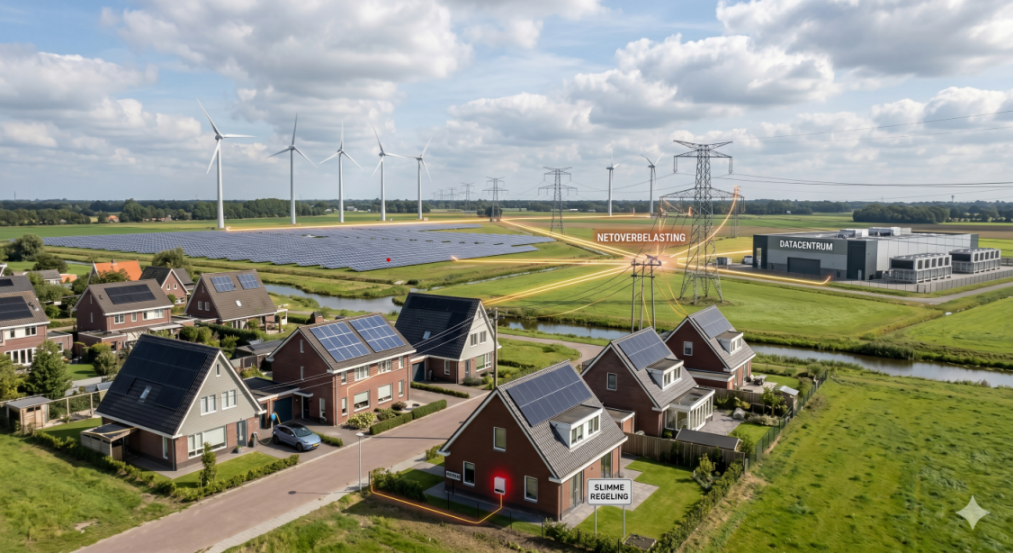
How do we keep the power grid and the citizen in balance?
Current challenges facing the electrical grid
The past few years have been dominated by sustainability. Consumers were (and are) heavily encouraged to invest in solar panels, heat pumps, and electric cars. This has been done on a massive scale, resulting in us generating enormous amounts of clean energy on sunny days. In addition, wind turbine and solar panel parks have sprung up like mushrooms. But this rapid growth also has a downside: our electricity grid is becoming overloaded.
To solve this problem, various scenarios are on the table. One of the ideas currently circulating is that energy companies should be able to remotely control the inverters of private individuals—the so-called ‘throttling’ of the installation during peak moments. Added to this is the fact that net metering will expire next year and the introduction of feed-in charges that almost everyone already has to pay…
The big puzzle
After all, it evokes a sense of inequality. For although the technology behind our energy grid is incredibly complex, the average citizen openly wonders: what about the big players? While consumers face extra costs and potential restrictions, we still see large solar parks rising in the landscape, wind farms being built, and new data centers consuming large amounts of electricity.
Naturally, major interests and complex network-technical reasons play a role here. Large parks can sometimes be more easily switched off centrally by grid operators than millions of individual homes, and industry has a different dynamic than a residential area. The consumer is completely baffled: the balance seems rather skewed…
Searching for a fair balance
The energy transition is pioneering work; we are now running up against the limits of a network that was not originally built for this. Everyone understands that intervention is necessary to prevent blackouts. However, it is important that there is more clarity regarding all of this, and particularly its fairness.
If citizens are asked to be flexible and help pay for the solution, it can also be expected that the major commercial parties and data centers contribute their proportionate share. Only then will we maintain support for a sustainable Netherlands.
Read more: Want to take active matters into your own hands to relieve grid congestion and avoid export penalties? Check out our complete guide on solar & home battery automation with Home Assistant, where we explain step-by-step how to dynamically curtail your inverters.